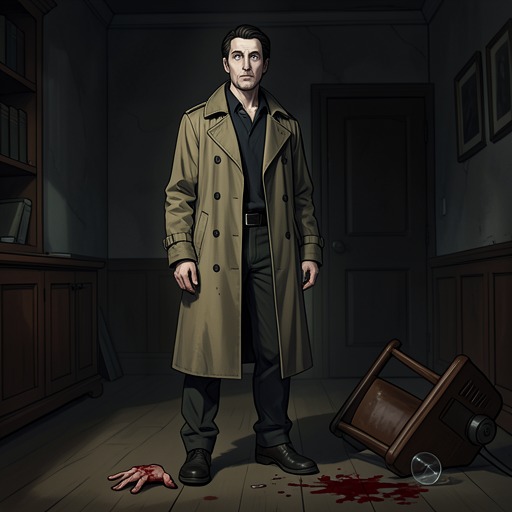
Gerry Wade’s death disguised as a chloral overdose
The Seven Dials MysteryGerald Wade’s death disguised as a chloral overdose is the mystery that turns an apparently ordinary death into evidence of murder. A bottle and glass beside the bed make overdose seem plausible, and the initial explanation appears simple; but Gerald’s unfinished letter, Loraine Wade’s recollections, and Ronny Devereux’s guarded warning all unsettle that conclusion. What first looks like a private mistake instead points toward Seven Dials and a threat Gerald had tried to keep from Loraine.
The apparent overdose
The first account rests on familiar, tangible details: chloral was by Gerald’s bed, along with a bottle and glass. A doctor considers an overdose the likely cause and regards the death as sad but straightforward, while acknowledging that an inquest will be necessary. At this stage, the available facts make a sleeping draught seem to explain the death without requiring anyone to imagine a crime.
Bundle Brent initially tries to reconcile that account with Gerald’s character. Remembering him as cheerful and full of life, she finds deliberate suicide difficult to believe. She considers an accidental overdose more likely: he might have taken a sleeping draught and mistakenly swallowed too much. Her reasoning does not yet establish murder; it shows how the apparent medical explanation can survive even as suicide becomes implausible. The distinction between intention and accident remains unsettled.
Clues the explanation cannot absorb
An odd detail about the clocks keeps Bundle’s attention. Seven clocks had been neatly arranged on the mantelpiece, while another had been found on the lawn outside, apparently thrown through the window. The displacement seems purposeless and difficult to attribute to ordinary tidying. It does not itself explain how Gerald died, but it gives the room an unexplained disturbance that sits uneasily beside the claim that the death is a simple domestic mishap.
The stronger contradiction comes from Gerald’s unfinished letter to Loraine. He writes that he feels exceptionally fit and is pleased with himself, then says he is too sleepy to keep his eyes open. In the same letter, he urges her to forget what he had told her about Seven Dials: what he had assumed would be a joke, he now recognizes as serious, and he does not want someone as young as Loraine mixed up in it. He begins another thought about Lurcher, but the letter breaks off before it can be completed.
The letter’s account of his condition conflicts with the overdose explanation as Bundle understands it. Gerald had been feeling well, yet on that very night he took enough chloral never to wake again. Bundle cannot make the two details fit. His warning about Seven Dials also gives the unfinished message a second significance: it is not merely a private note interrupted by sleep, but an incomplete attempt to protect Loraine from a danger he has come to take seriously.
Suspicion and the Seven Dials connection
Loraine confirms that the suspicion did not begin with Bundle’s reading of the letter. She has long believed Gerald did not die a natural death. In her recollection, he slept too well to need medicines that would make him sleep, and he himself had found the matter strange. Her certainty is rooted in familiarity with Gerald and in the mismatch between his habits and the explanation offered for his death.
Jimmy Thesiger connects the warning in the letter to a secret society. Gerald had spoken of the possibility of a society like the Mafia operating in England, initially treating the idea as a joke. Jimmy reasons that Gerald’s later insistence that Loraine forget what she knew means the danger was real: if the society suspected her knowledge, she too might be at risk. He warns that anyone continuing the inquiry could be endangered. This interpretation turns the letter’s vague reference into a possible motive for silencing Gerald, though the passage presents it as an emerging deduction rather than a completed demonstration.
Ronny Devereux supplies another sign that suspicion existed close to the time of the death. On the day Gerald died, Ronny began to tell Jimmy something while they were travelling to break the news to Loraine, then stopped because he was bound by a promise. Jimmy remembers Ronny as acting strangely and believes he suspected foul play, although the apparent evidence at the time had persuaded him that the case was clear. Ronny’s silence thus adds a concealed, incomplete strand to the mystery: someone may have known more than was disclosed, but the promise prevented the information from being passed on.
Narrative significance
The death’s disguise works because the visible evidence supports an ordinary explanation. Chloral, a bottle, and a glass make overdose immediately legible; the decisive complications arrive indirectly, through a letter that stops mid-thought, a displaced clock, Loraine’s knowledge of Gerald’s sleeping habits, and Ronny’s unfinished disclosure. Each detail weakens the appearance of certainty without, by itself, supplying the entire answer.
That gradual reversal makes Gerald’s death the point at which the investigation changes direction. What begins as a question of suicide or accidental overdose becomes a question of murder and of the secret activity named in his letter. Gerald’s attempt to shield Loraine also gives the clue personal stakes: the danger he recognized was not limited to himself. The initial medical account explains the scene, but the surviving fragments of his life expose how little that account can explain about the circumstances that led to his death.